Understanding the A* Search Algorithm: A Pathfinding Powerhouse
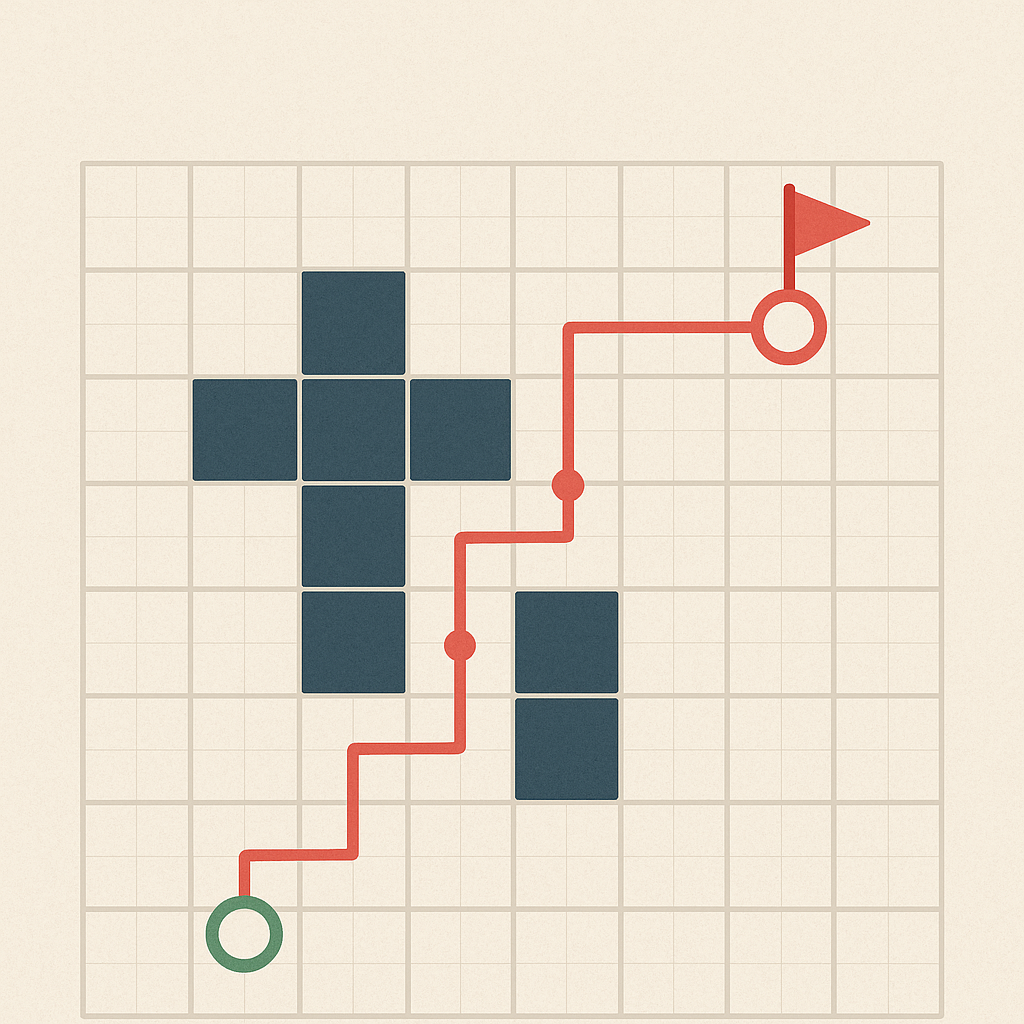
Image: The A* search algorithm
Introduction
In the world of algorithms, few are as elegant and widely applicable as the A* (pronounced "A-star") search algorithm. Whether you're developing video game AI, robotics navigation systems, or logistics route planners, A* offers an efficient way to find the shortest path between two points. In this 7-minute read, we'll explore how A* works, why it's so effective, and where you might apply it.
What is A* Search?
A* is an informed search algorithm that combines the strengths of Dijkstra's algorithm (which guarantees the shortest path) and Greedy Best-First Search (which is fast but doesn't guarantee optimality). It does this by using a heuristic to guide its search toward the goal while still ensuring it finds the most efficient path.
The Magic Behind A*
The algorithm evaluates nodes using a cost function:
f(n) = g(n) + h(n)
Where:
g(n)= exact cost from the start node to current nodenh(n)= heuristic estimate of cost fromnto the goalf(n)= estimated total cost throughn
Key Properties
- Admissible Heuristic: For A* to be optimal,
h(n)must never overestimate the actual cost to reach the goal. - Consistency: The heuristic should satisfy
h(n) ≤ cost(n to n') + h(n')for any neighborn'.
How A* Works: Step by Step
- Initialize the open set with the starting node
- While the open set isn't empty:
a. Select the node with lowest
f(n)b. If this node is the goal, reconstruct and return the path c. Generate the node's neighbors d. For each neighbor:- Calculate tentative
gscore - If better than previous, update and add to open set
- Calculate tentative
- If open set empties without finding goal, no path exists
Choosing a Good Heuristic
The heuristic makes or breaks A*'s efficiency. Common choices include:
- Euclidean distance: Straight-line distance (great for open spaces)
- Manhattan distance: Sum of absolute differences (good for grid-based movement)
- Custom heuristics: Domain-specific estimates for specialized applications
Practical Applications
- Game Development: Pathfinding for NPCs in games like Starcraft or Civilization
- Robotics: Navigation in dynamic environments
- Transportation: Route planning in GPS systems
- Puzzle Solving: For problems like the 15-puzzle or Rubik's cube
Advantages Over Other Algorithms
- More efficient than Dijkstra's (expands fewer nodes)
- More reliable than Greedy Best-First (guarantees optimal path)
- Flexible through heuristic choice
Limitations to Consider
- Memory usage grows with search space size
- Performance depends heavily on heuristic quality
- Not ideal for dynamic environments without modification
Implementing A* (Pseudocode Example)
function A_Star(start, goal):
    open_set = {start}
    came_from = empty map
    g_score = map with default value of Infinity
    g_score[start] = 0
    f_score = map with default value of Infinity
    f_score[start] = h(start, goal)

    while open_set is not empty:
        current = node in open_set with lowest f_score
        if current == goal:
            return reconstruct_path(came_from, current)

        open_set.remove(current)
        for neighbor in neighbors(current):
            tentative_g = g_score[current] + d(current, neighbor)
            if tentative_g < g_score[neighbor]:
                came_from[neighbor] = current
                g_score[neighbor] = tentative_g
                f_score[neighbor] = g_score[neighbor] + h(neighbor, goal)
                if neighbor not in open_set:
                    open_set.add(neighbor)

    return failure
Conclusion
The A* algorithm remains one of the most important tools in computer science for pathfinding problems. By intelligently balancing between exploration and exploitation through its heuristic function, it finds optimal paths efficiently across numerous domains. Whether you're a game developer, robotics engineer, or algorithm enthusiast, understanding A* will serve you well in solving complex search problems.